
 EN
EN
Why Engineering Contractors Choose OEM Trackless Electric Flat Cars
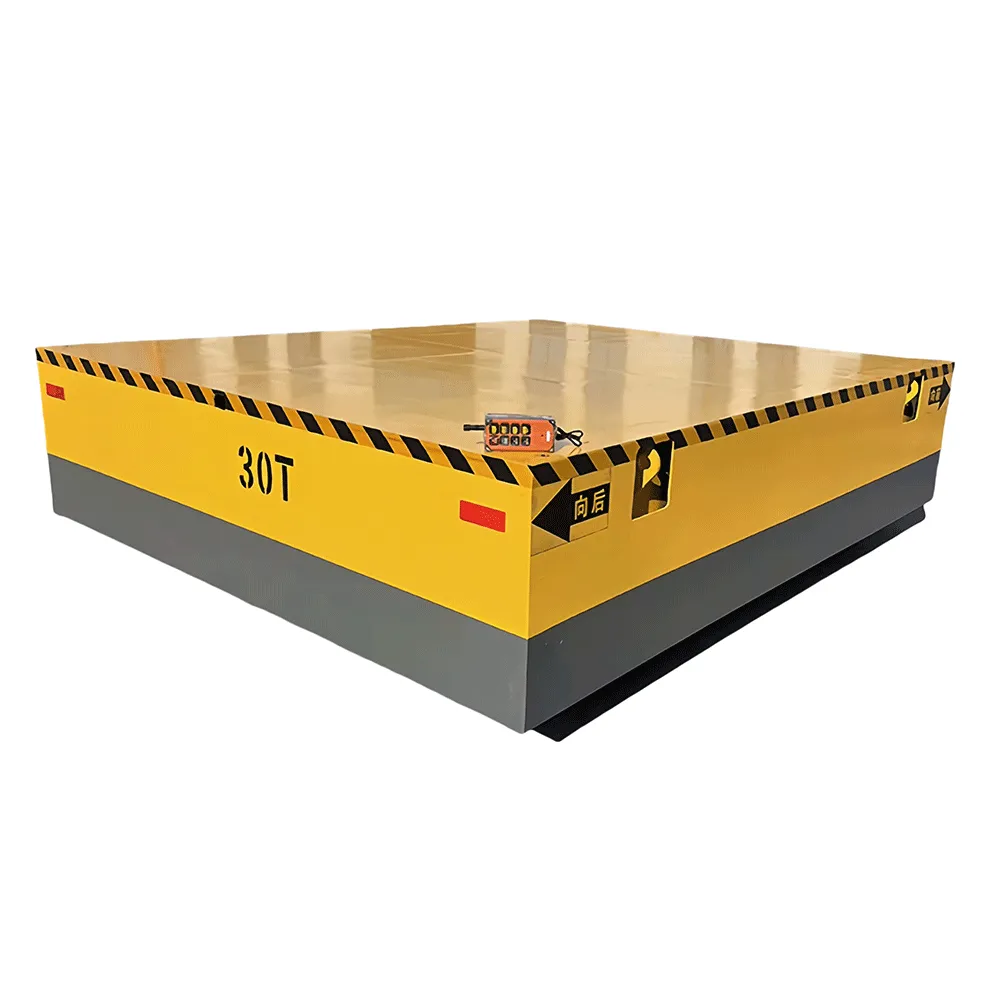
Engineering contractors managing heavy infrastructure, modular construction, and industrial relocation projects increasingly select OEM trackless electric flat cars for tailored, zero-emission material transport. Unlike off-the-shelf units, OEM partnerships enable deep design integration: chassis reinforcement for unstable ground, high-density lithium battery packs for multi-shift runtime, and precision remote-control systems that support inch-perfect maneuvering in cramped or dynamically configured job sites. This customization directly reduces idle time—Plant Engineering (2022) found purpose-built electric carts cut load-handling rework by 22%. OEM-led structural validation and on-site commissioning ensure compliance with local safety codes and precise load requirements (10–50 tons), eliminating compromises inherent in rail-dependent alternatives. Engineered platforms also lower total cost of ownership: Deloitte (2023) reported up to 30% reduction in unplanned maintenance versus standard models. Route flexibility—no track laying required—preserves schedule certainty across evolving project layouts. The result is a durable, emission-free asset aligned with tightening environmental mandates and proven to strengthen safety performance on multi-year, high-stakes programs. This convergence of reliability, adaptive design, and predictable lifecycle economics makes OEM trackless electric flat cars a strategic investment for contractors prioritizing uptime and operational control.
OEM Customization Process: From Load & Terrain Requirements to Commissioning
Every engineering project introduces unique constraints—uneven ground, confined spaces, or atypical load distribution. Generic trackless electric flat cars rarely meet these demands without costly field modifications. The OEM customization process transforms site-specific inputs into a purpose-built solution, ensuring seamless integration into the contractor’s workflow from day one.
3D Simulation, Structural Reinforcement, and Battery Integration for Site-Specific Demands
The process begins with a detailed load and terrain analysis—capturing maximum payload, surface gradient, turning radius, and operating environment. Engineers input these parameters into 3D simulation software, performing finite element analysis to identify stress concentrations and predict frame deformation under real-world conditions. Based on results, the chassis receives targeted reinforcement: additional crossmembers, thicker steel plate, or enhanced weld joints where loads concentrate. For example, moving heavy steel coils over uneven factory floors may require a reinforced deck and low-profile wheels to maintain stability.
Battery integration follows the same precision logic. OEMs match chemistry and capacity to duty cycle—not just peak demand. A 16-hour continuous shift warrants a high-capacity lithium pack with opportunity charging; intermittent use may justify a cost-optimized lead-acid system. Energy consumption is modeled across the planned route to verify full-shift operation without mid-cycle recharge. This integrated approach ensures the unit arrives pre-configured—not adapted—to the site’s exact physical and operational demands.
End-to-End Engineering Support: Design Validation, Prototype Testing, and On-Site Commissioning
After finalizing the 3D design, OEM engineers validate structural calculations, electrical schematics, and safety interlocks against ISO 3691-4, ANSI B56.1, and local regulatory standards. A prototype undergoes rigorous testing: static and dynamic load trials at 125% of rated capacity, endurance cycling over 1,000+ cycles, and emergency stop response verification. Any deviation triggers design refinement before production.
Upon delivery, OEM engineers oversee on-site commissioning—verifying sensor calibration, remote-control responsiveness, navigation accuracy, and emergency system function in situ. They train operators on safe operation, preventive maintenance, and fault diagnostics, and deliver comprehensive documentation including as-built drawings, maintenance schedules, and compliance certificates. This hands-on support eliminates ramp-up delays and prevents costly post-deployment rework.
Trackless Electric Flat Car Applications Across High-Demand Engineering Environments
Precision Remote Operation in Confined, Uneven, or Temporarily Configured Job Sites
Trackless electric flat cars thrive where fixed infrastructure is impractical or impossible. Wireless remote operation enables precise movement through narrow corridors, around temporary obstructions, and across uneven surfaces—including unpaved ground, gravel pads, or laid steel plates—without rails or guide paths. Integrated anti-collision sensors, obstacle detection, and redundant emergency stop systems maintain safety even in low-visibility zones like tunnels, basements, or partially enclosed retrofit sites. Crab-steering and 360° rotation eliminate manual load repositioning, reducing labor risk and accelerating placement. For instance, installing heavy equipment inside an unfinished structure achieves millimeter-level accuracy—avoiding costly delays caused by misalignment or crane dependency.
Scalable Load Capacity (10–50 Tons) via Modular Chassis and Powertrain Options
Scalability is engineered—not retrofitted. Modular chassis architecture uses standardized, reinforced steel sections that extend or widen to accommodate larger payloads. The powertrain—typically AC motor-driven with regenerative braking—is upgraded incrementally: higher-torque motors, dual-drive axles, and expanded battery capacity scale performance without redesigning the core platform. Contractors select configurations from 10 tons (light machinery handling) to 50 tons (transformer or turbine transport). Interchangeable components—wheel sets, steering modules, control interfaces—enable rapid repurposing. A 20-ton unit used for steel beam delivery, for example, can be upgraded to 40 tons by adding a second drive axle and a higher-capacity battery—extending service life and maximizing asset utilization across diverse projects.
Trackless vs Rail-Based Carts: Operational ROI for Short-Term and Multi-Project Deployments
For contractors operating across short-term or multi-project deployments, trackless electric flat cars deliver faster ROI by eliminating fixed infrastructure. Rail-based systems require surveying, grading, track installation, and cable routing—adding weeks to deployment timelines and locking capital into site-specific assets. In contrast, battery-powered trackless units achieve operational readiness within hours, requiring no ground modification (RMK, 2024). When projects conclude or relocate, the cart simply drives to the next site—retaining full value across contracts. Maintenance favors trackless designs: routine tire rotation and battery health monitoring remain significantly less intensive—and less costly—than ongoing rail alignment, weld inspection, and cable replacement. This agility, combined with lower lifecycle maintenance, delivers a measurably lower total cost of ownership for contractors whose work demands mobility, speed, and asset reuse.
FAQ
Why are OEM trackless electric flat cars preferred for engineering contractors?
OEM trackless electric flat cars provide tailored, zero-emission solutions that reduce idle time, meet specific load and terrain requirements, and comply with safety codes. They also lower maintenance costs and offer route flexibility without track installation.
What factors are considered during OEM customization?
OEM customization considers load capacity, terrain analysis, chassis reinforcement, battery type and capacity, and site-specific design requirements validated through simulation and testing.
How do trackless electric flat cars improve mobility?
Trackless electric flat cars offer wireless remote operation, precision maneuvering, and adaptability across confined spaces without the need for fixed rail infrastructure.
What load capacities do these trackless electric flat cars support?
Load capacities range from 10 to 50 tons, made possible through modular chassis architecture and scalable powertrain upgrades.
How does the operational ROI of trackless electric flat cars compare to rail-based systems?
Trackless electric flat cars achieve quicker ROI due to reduced setup costs, faster deployment, and lower lifecycle maintenance compared to rail-based systems, which require significant infrastructure investments.
Table of Contents
- Why Engineering Contractors Choose OEM Trackless Electric Flat Cars
- OEM Customization Process: From Load & Terrain Requirements to Commissioning
- Trackless Electric Flat Car Applications Across High-Demand Engineering Environments
- Trackless vs Rail-Based Carts: Operational ROI for Short-Term and Multi-Project Deployments
-
FAQ
- Why are OEM trackless electric flat cars preferred for engineering contractors?
- What factors are considered during OEM customization?
- How do trackless electric flat cars improve mobility?
- What load capacities do these trackless electric flat cars support?
- How does the operational ROI of trackless electric flat cars compare to rail-based systems?